
What Is The Best Rock Climb In Aotearoa?
By Tom Hoyle
I apologise for the gratuitously click-baity title, of course we can't possibly say that one climb is better than all others in the country. But, we can make a short list of contenders and discuss the aspects that make them worthy. Won't that be fun? But what are the aspects that make a good climb, and how relevant is that really to my climbing as hard as possible?
Perhaps the worst kept secret in rock climbing is that grades are just a made up number. The fact is that a simple number can't possibly represent the complex web of difficulties on any given rock climb—given the variance in physical characteristics of all rock climbers. What's even worse is that these fake news numbers are ushered into existence by an underground mafia of guidebook editors and egotistical first ascentionists. Total nightmare. Now, grades aren't complete nonsense by any means, but they are also just someone's inherently biased guess and should be approached as if having a generous margin of error. Exactly how generous that margin of error is, is dependent on how far removed from the average you are in any of the characteristics of height, finger strength, hip mobility etc etc. And yes, there is an implication here that guidebook editors are exceedingly average individuals, or if not they should be.
But executive authority over the perceived difficulty of a climb isn't the only super-judicial power exercised by guidebook editors. They also have the opportunity to dictate the quality of a climb. While many serious climbers mistake the difficulty of a rock climb as the primary value statement to make about a climb, the quality of the climb is an independent metric and arguably a more important one.
The perceived quality of a climb really comes down to whether a climber had a good experience on the climb, or not. So surely approaching any climb with the right attitude can lead to a good experience? This is true to an extent, but setting people's expectations as to what kind of experience they might have on a climb is a useful way of aiding them in approaching a climb with the right attitude. If a climb gets no stars because it is a wet and dirty off-width with sparse protection and a gorse bush growing on the mantel ledge at the finish, a climber can still have a good experience on it by approaching it with a 'jungle warrior' mindset. They might see that it has no stars, observe from the ground the lack of holds formed of stone but the cornucopia of choss and vegetation but decide they want that kind of challenge and attack it with relish. But if a less-confident climber mistakenly gets on the same route because they think it is the three-star, grid-bolted Stairway To Heaven, famous across all the lands as the finest rock climb this side of Evermore, they're going to have a bad time. So stars are useful in much the same way as grades—to help people set their expectations.
There are many internal factors as to why someone might have a good, or bad experience on any given climb. But we need to put these aside and try to look at the climb objectively, because we can't possibly guess the state of mind and precipitous sandcastle of self-worth any given climber will tie in with on any given day. It does seem that not all rock climbs are of equal value, even if someone can have a good experience on any rock climb. So, as with grades, there is an attempt towards intersubjectivity in discussing the quality of climbs, even though it is impossible for a truly objective outcome. How do we go about this?
Guidebooks in our country generally use a three star rating system for rock climbs. Or occasionally a one star system. Climbers who have climbed in other countries will have noted these rating systems vary, but perhaps the most notable variance is quite close to home—Australia. Simon Mentz and Glenn Tempest's iconic Arapiles Selected Climbs sensibly uses a three star system for a crag that remains a contender for the best in the world and is home to rock climbs as good as it is possible to find on this planet. However, in a blatant escalation of the inter-state rivalry between New South Wales and Victoria, the Blue Mountains guidebook uses a five star system. Is the implication really that their best climbs are better (by two stars!)? By the same logic you could argue that it might mean their worst climbs are two stars worse. Most likely, their delicate sensibilities (is there a more sensitive national psyche than the Australian? ;-) ) are just so in tune with the rock and the variance of quality in their stone demands a finer scale by which to grade.
To make an attempt to identify objectively observable qualities of rock climbs that are more likely to give people good experiences, we need to think of what makes climbing enjoyable. This might be an old-fashioned attitude, but I'd suggest that part of the appeal of climbing is tip-toeing a line of danger, or at least perceived danger, a sense of sticking your neck out. This is achievable on a rock climb without it actually being dangerous due to bad bolts, loose rocks or flagrant run outs (all factors that are likely to knock off a star). Any climb that is long can give this sense, or a climb that by it's topography creates a sense of exposure, for example by forcing a climber around an undercut arête, or up a roof after an initial face, or even by just being on a hillside already, which perhaps falls away into a lake or sea (think Jane Fonda Workout Wall, Lovers Leap or Kawakawa Bay). A four-metre sport route with three bolts is never going to be the best climb in the country.
Another undeniable appeal of climbing is the problem solving factor. Arrange a series of directional holds in a particular formation and you demand the climber move their centre of gravity in particular ways at particular times as they move their hands and feet in a particular order through the holds and apply pressure in particular directions to succeed. What at first may seem baffling and impossible can be unlocked with persistence and creativity, there's no ore satisfying feeling and this is one of the reasons climbing can be so addictive for a certain type of mind.
A third aspect is best summarised as aesthetics. While this might apply to the sequence of climbing movement, as just described, it also applies to the rock itself. Climbs that take a striking feature of rock, be it a continuous crack, a searing arête, or a tufa line on a sheer face have an immediate appeal that can pull climbers to them. Within this, the quality of the rock can also be aesthetic, stone that is too sharp, or too smooth can be off-putting. But a climb with beautifully textured stone and interesting but friendly holds is bound to create a better experience.
With these factors in mind, we can roughly equate the three star quality system to a star for each of scale/exposure, climbing sequence and aesthetics. But it is worth reiterating that a climb can tick all of these boxes and still not be a three star climb, because as stated above there are a few negative factors that can remove stars. For example, a climb might generally be of good quality stone and an aesthetic line, but have one loose block which means it should lose a star (and probably have some maintenance done). Or the protection may be poor because the fixed hardware is outdated or poorly installed. Or it might just have a ledge below the crux which people are likely to hit if falling on the crux. Maybe it has a section which often seeps or is wet with snowmelt. Link-up routes can be lots of fun for climbers who have run out of things to do, but they are never likely to get a lot of stars because they are really annoying for guidebook authors. Or, to dive deeper into subjectivity, it might have mantel move on it at any point—mantels on routes erase all stars.
With this long-winded and poorly-defined criteria in place, we can now discuss a few contenders for the best routes in New Zealand (apologies to Winston for trying to change the name of this country in the title).
Little Babylon is likely the crag in the country with the highest average number of stars per climb. There are many contenders here: Solitude (25), Hellboy (28), Colossus (33), No Country For Old Men (29), Moses (27) and Jugular (25) are all climbs with good scale, beautiful stone and great sequences at the grade. All worthy contenders.
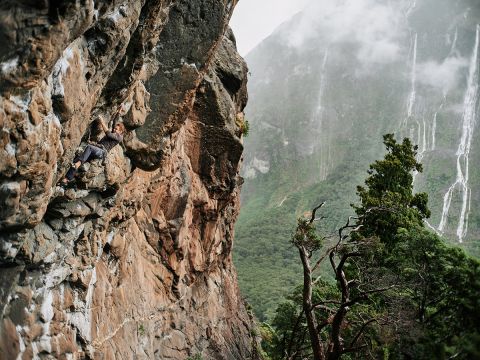
Down at Big Babylon things are a bit more complicated, with multiple pitches muddying the waters on the left wall, and tiny holds making my fingers and toes hurt on the right wall. Nevertheless, climbs like Fuel (29), Katalepsis (32), Project Aqua (24), Piopiotahi (28), PSI (25) all are absolute stunners.
You might think multi-pitch routes are cheating, because they have an automatic win on the scale factor and just generally more real estate in which to contain excellence. You're partly right, they do have better scale and for this reason many climbers think they give a richer experience than single pitch cragging. But they also have more real estate in which to contain a negative star-removing factor, so I think the comparison is still fair to make.
With multi-pitch routes in mind, it is hard to go past Labyrinth (22) on Barrier Knob. Lucky Strike (20) on Moir's Mate is very popular, but a loose block on the crux is a negative. Pipe Dreams (21) or Finders Keepers (22) might be stronger contenders, but personally I don't think the quality of climbing is consistent enough throughout the pitches for them to be the very best, just merelt excellent. Nearby Vindication (25) has some stunning climbing, but has been wet on the crux pitch both times I've visited.
If you spend any time in the Darrans you'll hear whispers about the Central Darrans and the best climbs in the country, some of which are first ascents, just waiting for your visit. This is of course utter nonsense, predicated by old-timers who prefer long rambles with heavy packs to actual climbing. Don't bother to verify this for yourself. Likewise, Copper Point is a scam initiated by elitist boat owners to remind the common climber of their superiority, the climbs there are total choss, especially on Boaty McBoat Face.
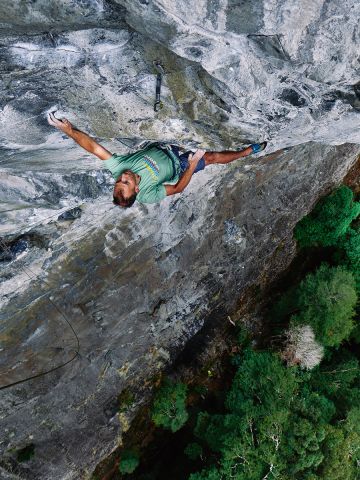
Before we let the rest of the country get a look in, there's still Chasm Crag in the Darrans. Somewhat neglected since the advent of Babylon, One Way Ticket (24), Groove Armada (23) and Bus t'Milford (26) are all excellent, but maybe not the very best due to the additional logistics.
You might think it strange to start at the bottom of the country, but the scale and rock quality of the climbs in the Darran Mountains area really is hard to compete with.Nevertheless, there are a few other contenders worth mentioning.
Dunedin's Lovers Leap has loads of character and good scale, climbs like Parallel Universe (25) and Demilitarised Zone (27) might seem like contenders, until you actually compare them to the best of the Darrans offerings.
Queenstown's Wye Creek is another great crag, with amazing views over Lake Whakatipu. The Mission (16) is a long, engaging climb at an accessible grade, well worth the walk on its own.
Wānaka has a wealth of accessible routes and is a stunning destination. The quality of the schist is variable however. Al Cap has likely the best stone and scale in the area, with Continuous Play (27) and Righteous (27) both incredibly popular. Some of thre harder offerrings are likely contenders too, if you have the crimp strength. It's also hard to go past Falcon Steep (22) at The Cutting, probably the signature Wānaka face climb.
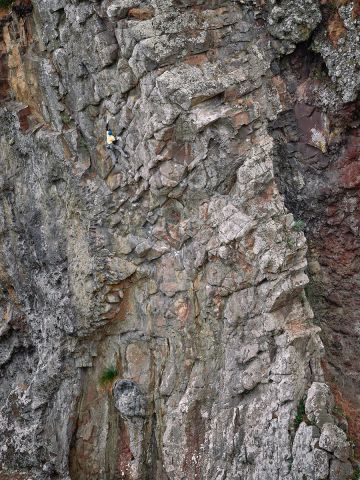
Moving north we get to Canterbury's Port Hills and Banks Peninsula. A lot of these volcanic crags leave a lot to be desired in terms of scale and rock quality, but the oft-overlooked Jane Fonda Workout Wall is an exeption. The standouts here arethe Bill McLeod classic Melting Point (25) and Dave Fearnley's Flock To The Rock (27). At five bolts in 20 metres Flock is arguably too spicy for most palates. Melting Point is well bolted after the fairly ridiculous starting run-out. I'm yet to meet someone who has climbed it that didn't think it wasn't worth the risk though. In my mind, Melting Point is probably the best rock climb I've done north of the Darrans and south of Whanganui Bay.
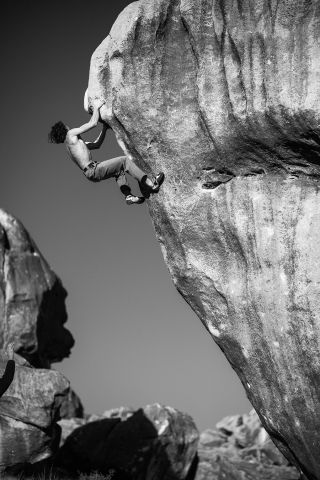
From here we go west to Castle Hill Basin and encounter a serious problem. Yes, there are routes here and some of them are good. See Dance Of Silence (29), Chocolate Coated Razorblades (26) and Adios Gringos (25) for prime examples. However, the bouldering is better. It just is. Some people don't boulder, they just climb routes and think bouldering is just kind of messing about at the bottom of the wall because you are scared of heights and too povo to own a rope and harness. To those people, I would ask, have you stood beneath Solaris or Horsemen Of The Apocalypse? Who's scared and struggling to get off the ground now? The unfortunate answer for the concept of this piece, but fortunate answer for the boulderers of Canterbury is that yes, the best rock climb in Aotearoa might just be a boulder problem at Flock Hill. But lets pretend bouldering isn't real and carry on.
Further north we get to the Fyfe River Gorge. These climbs might be too far of a walk and too sharp to be contenders, but at least three people have told me that Megalomania (25) might be the best climb in the country. That route now has an extension and there are 11 othe routes on that same wall with three stars on ClimbNZ! Maybe if you haven't been you need to go? Gold Strike and Eldorado both look great too and likely have some candidates.
Then we get to Paines Ford. There are some really excellent routes at Paines Ford and it is hard to not have a great time climbing there. Especially at the Globe Wall. And maybe Dancing On A Skewer (28) is the complete rock climb? It's definitely worth having a go to find out.
At this point you might be thinking, 'what about such and such a crag?' If I've skipped over it I have either made a moistake, or it isn't as good as you think. Just presume it's the first.
The North Island won't take as much time to cover, because there are only two crags that could possibly have a contender. Yes, there are good climbs at Wall Of Sound, Waipari etc, but they just aren't that good. Other crags have been closed. Kawakawa Bay has some great scale, an impressive outlook and some very good climbs amongst some strange development choices. The 45-metre High Hopes (16) is a spectacular climb. The Hecklers (19) is also a fantastic trad climb.
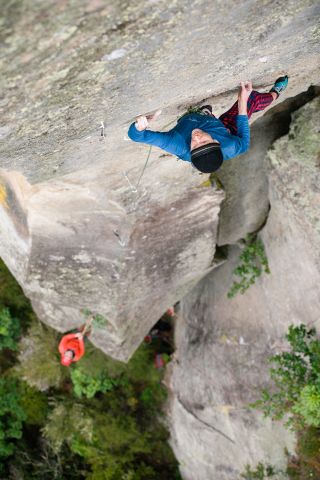
Last, but by no means least we get to Whanganui Bay. Some climbers have been put off this crag by the limited access season, reports of the dodgy road and/or having to pay a token amount to climb. If you like rock climbing and have the opportunity to go to this crag, you should not hesitate. It still offers, in my mind, one of the best climbing experiences you can have in this country. There are many searing lines here in a unique climbing style. On Patrol In The Ruins Of Your Body (23), Zen (23), Drive In Bank (25), Sister Europe (22), Turbomingent Torremounting Tossers (22)—it's truly hard to choose just one.
I'm not going to choose a winner, but I think these contenders are all worth thinking about. If you want to vote for a winner, add it in the comment field below. Disagree with my choices? Nominate your own climb below. If we get enough votes maybe we'll announce a winner, but probably not.
All photos by Tom Hoyle except the main banner, which is by James Morris.
Going on your selection I'd say if we climb less than grade 25 in NZ just go to Australia because according to you there's very little below that grade worth doing here!
Richard, you don't seem to have understood the article at all. You are right that at more moderate grades Arapiles is a better place to find the most excellent climbs at the grade, compared to New Zealand. But that doesn't mean there aren't climbs in New Zealand worth doing at those grades and nowhere in the article do I suggest that.