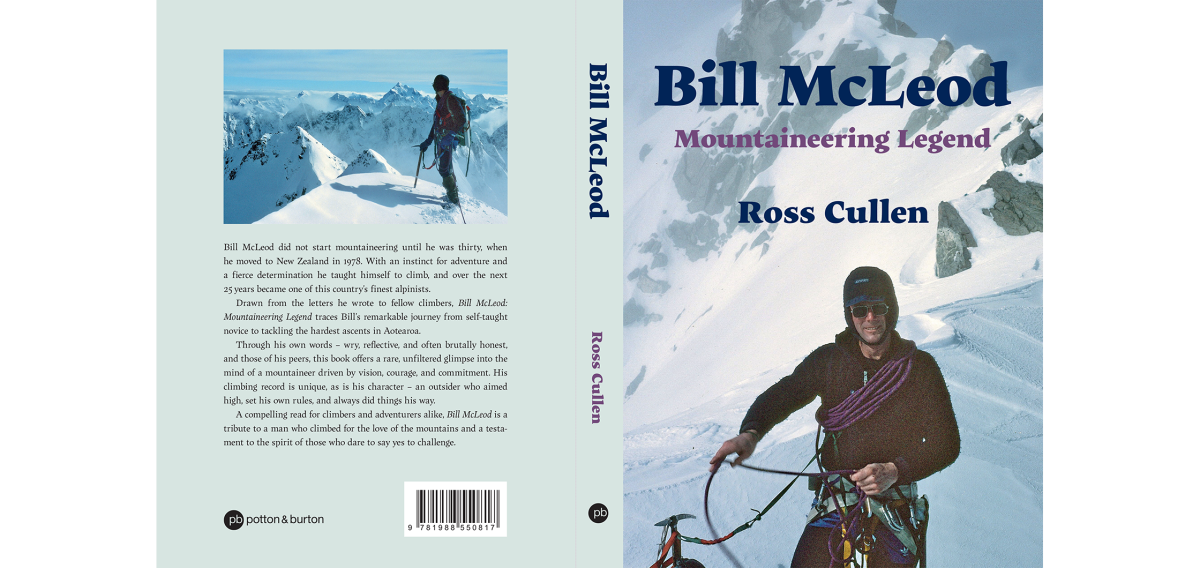
Bill McLeod: Mountaineering Legend Book Review
By Ross Cullen, with Pip Lynch
Bill McLeod is a phenomenon who blazed across the New Zealand mountaineering firmament between 1979 and 2005.
Bill only start climbing when he was 30 years old. He moved from the burning plains of Western Victoria to the rain of Fiordland specifically to climb mountains, based for a few years with jobs at the Tourist Hotel Corporation hotel in Te Anau. In western Southland and the Darrans he built his alpine skills. Then, in a typically planned and deliberate way, he focused on a selection of our countries’ highest peaks—Aoraki Mt Cook, Tasman, Hicks and La Perouse—via the hardest routes, in winter, and often alone. All the while he worked on his rock-climbing and methodically lifted his grade range to routes of grade 27. Once more, he shifted focus. He pivoted to alpine rock—Cloudy Peak in the Havelock valley, and the big, hard, little-known peaks in the Huxley, Hopkins and Dobson valleys. Here he created at least fifty new routes (with some of the hardest climbed in winter, and so 'alpine rock' is a bit of a misnomer). At least half these of these routes were solo ascents.

Bill stands at the forefront of the great New Zealand climbers of the late 20th century—alongside the likes of Bill Denz, Nick Cradock and, slightly later, Guy McKinnon. What sets Bill McLeod out from the others, however, is his personality. He is, as the book says, an enigma. This, for me, is the heart of Ross Cullen’s biography. It skilfully combines a narrative timeline with articles from the New Zealand Alpine Journal and Canterbury Mountaineer and then weaves in exerts about Bill from letters and recollections from climbing partners. The letters bring to life Bill’s personality and his evolving approaches to the mountains. As the author says, Bill is unusual: incredibly focused on climbing, obsessive, and reclusive. The letters reveal, too, warmth, an analytical mind, joy in his experiences, at times intense worrying, and a deep love of the mountain world from its most savage extremes to its benign beauties.
I’m reminded of the idea that there can be a dizzying balance between genius and madness. Bill was certainly a genius climber, just as he could also be consumed by worry. Bill was a very deliberative climber, one careful move after another, moving steadily, and equipped for whatever the mountain threw at him, including bivvying. His style sometimes bothered companions who preferred to move fast and light, but Bill rarely made a mistake, as his record shows.
Bill gave up employment in the early 1980s. From then till the early 2000s he lived in a van and, notoriously frugal, seemed to subsist on a benefit. He was drawn increasingly to the Mackenzie Country. In 2001 he bought a house in Twizel. As his climbing days wound down and injuries accumulated, he took to exploring the basin on bike and on foot. Additionally, he devoted his time to shortwave radio, a pastime known as DXing. Now in his late seventies, the focus of Bill’s life is the Basin, biking, and his radio.
This book is thoroughly recommended. Ponder in awe Bill’s solo ascents of the Yankee-Kiwi Couloir on Mt Hicks, or his big solo first ascents on Abseil Peak, Gormenghast on the South Face of Hopkins or Megawatt on the East Face of Mt Townshend. Read it to understand what made Bill tick as a cutting-edge climber. But above all, read it to enjoy the life story of a legendary mountaineer.
Review by Hugh Logan