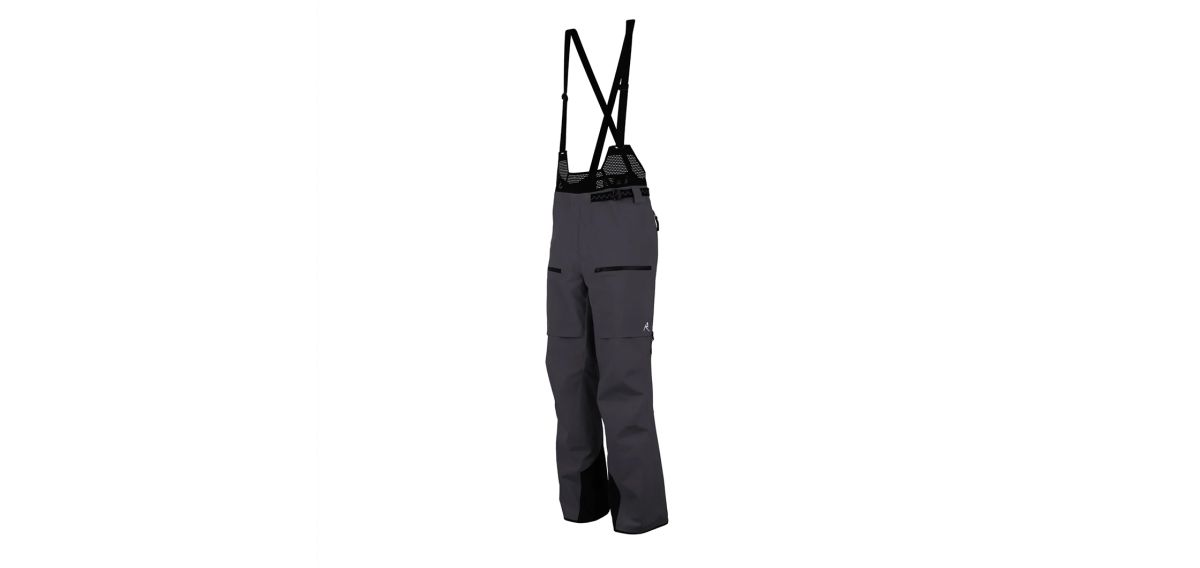
Raide Research TourTech Bib Review
By Tom Hoyle
Ski touring is a tricky activity for which to nail all your gear choices. You want skis, boots, bindings as light as possible to make the 'up' efficient and comfortable. The 'up' is usually more than 90% of your time, but nevertheless, you want that same equipment to perform on the descent, because that is the main point of the activity. Just choosing the lightest gear doesn't usually maximise the fun on the descent, hence the wildly variable weights and designs of skis, boots and bindings as a constantly expanding myriad of categories give consumers more and more choices of where to draw the line of compromise. Some people tour in modified race boots, while others ski wildly-intimidating terrain on tiny skis that seem mere toothpicks and yet others carry parts of alpine bindings in their pockets so they can skin on pins and descend like they're in the resort. The array of possibilities is bewildering to navigate.
Apparel for ski touring is no different. You are in the snow and at altitude, so there's a minimum level of weather protection that is sensible, at least for most folks. But you're also undertaking a high output activity, often with the strong solar of late spring (it seems to get later every year) and damn it if the sun doesn't bounce off the snow and make you warm. Getting absolutely cooked on the ascent is a sure fire way to ruin your day. It means you need more water, it negatively affects your physical and mental performance and if you exhaust yourself and wet out all your clothes, you are also a hypothermia risk if the weather changes or in the event of injury. All of which should be avoided, if possible. Good weather protection—while allowing for a high level of breathability—is the unicorn combination of qualities that all alpine apparel manufacturers have been chasing since forever.
While three or two layer 'hardshell' fabrics have been the benchmark for weatherproof ski apparel for many decades, even the most breathable of these can feel like you're jogging in a plastic bag. At least with the upper body it isn't too inefficient (though not optimal) to have a jacket that is removed for the ascent and put on at transition time. But for the lower body, once you have ski boots on your feet, you really want to be able to set and forget. Add in an array of zippable vents on the thighs of a hardshell pant or bib and you start to make something useable. An alternative approach is to go for a 'softshell' fabric. These have the same water repellant treatment of the outer textile, but lack the backing membrane to be effectively 'waterproof'. Softshells breathe a lot better, but in bad weather they can wet out and aren't as windproof, which means you can become very cold very quickly in unfavourable conditions. With New Zealand's maritime climate, some people won't take the risk of relying on softshell garments. Others don't run that hot and will happily make their way up a 45 degree slope in a hardshell suit with merino baselayers, somehow. This may seem absurd, but meanwhile people in dry continental climates are happily skiing in jeans and down jackets (in the resort at least). As with the skiing hardgoods mentioned above, everyone needs to find the compromise that works best for their own needs. But for those who run hot and still want a decent safety margin of weatherproof properties, what are the best options? Has anyone truly nailed the waterproof and breathable ski touring pants?
According to new players on the scene, Raide Research, the answer is 'not yet'. As their copy for the TourTech Bibs states 'We felt like the perfect ski touring pant didn't exist so we made it. The TourTech Bib presents the best of both worlds offering a breathable softshell fabric in the upper half and a waterproof, breathable hardshell in the lower half. This allows your high output areas to breathe, while the areas that interface with the snow more frequently have waterproofness.' Sounds promising!
It's worth pointing out that these aren't the only hybrid of this type on the market, but nevertheless they are outside of the norm and the first I've had the opportunity to try. I have quite a bit of experience with Strafe's Cham pants, which many describe as the most breathable hardshell ski touring pants on the market—and I've found so far that the Raide bibs run cooler. Part of that is definitely the performance of the softshell fabric in the upper part of the bibs, around the thighs and waist. I also think that being a bib is an advantage here, counterintuitively. Generally bibs' extended coverage is a boon in winter, offering warmth, better coverage and jacket integration to avoid that nasty pow getting down your pants in the event of a mishap. But I've always avoided bibs for touring outside of winter, as the last thing I want is more coverage when I'm overheating. In the case of the TourTech bibs, they are only marginally higher cut than a pair of pants, but the mesh in the upper part is highly breathable and the suspenders holding them up mean that you don't need them tight at the waist. Having them looser around the waist than pants means that hot air can escape up out of the top of the bibs, something that pants with thigh vents don't achieve as easily. Of course, the TourTech bibs have thigh vents as well, allowing good airflow in the vents and out the top.
In fact, the TourTech bibs have every other feature you could possibly want too: easy entry and a dropseat with a long zip on one side, snow gaiters that even include a little zip for accessible boot faffing, double thigh pockets with generous space and an elasticated inner sleeve for your beacon, an upside down fly, and kevlar kick patches. The waterproof treatment is PFAS free and how this will hold up is still a question with the change in this technology, but all manufacturers are in the same boat on this and the seams are fully-taped, so Raide have done their best to make these as weatherproof as they can. This spring being what it is, I can definitely vouch for the waterproofness of the lower leg hardshell material on soggy bootpacks, as well as the windproof qualities of the upper softshell part. Certainly they're not as windproof as a burly three-layer resort hardshell fabric, but I'd say the fabric does at least as good a job as lighter hardshells like the Strafe Cham pants—and if the design can do that as well as breathing better, it's a winner in my book.
Am I concerned about the ultimate weatherproofness of the upper softshell? To some degree, but a long jacket covers a lot of this area and a five year guarantee doesn't hurt. Given the performance of these bibs in terms of heat management and comfort on both ascents and descents (the cut is great for me), I'm likely going to find out as I'll be using these a lot. It is worth noting Raide make the mens version in both a short, regular and tall version of each size small through extra-large, which is great to see. In the women's there is both a short and regular across all four sizes. These are the extra details that show functional design and good user experience has been prioritised at every stage with producing these.
Of course, all that adds up to a bib that isn't cheap. You're looking at boutique gorpcore prices that rival brands like Arc-Teryx. That's not attainable for everybody, but if you want something with this level of design, refinement and quality then you are going to have to pay for it. All I will say is that if you are going to pay this kind of money for a bit of outdoor clothing, then you want to be satisfied with using it and feel like you're paying for quality fabrics, manufacturing and things like the expanded range of sizing, which all add cost to making the product. This is different to paying a lot of money because something represents a certain image or brand value that is intangible. It's also worth noting that this price (NZ$795) includes free shipping from the US, which is your only choice as you won't find them in stores.
My only criticism would be that the available colours are limited and a little drab. An off-black in both the men's and women's—which I've found thankfully to be more appealing in the hand than it looked online— and a beige variant (Dusty Tan officially) for men. The women's variant of a sage green is more appealing, and it'd be nice to see the colour range expand to something brighter for the men too. But given what we've already acknowledged about the size range and this impact on price, I wouldn't want to have to pay more for more colours to exist. Perhaps with scale the business case might work.
Those quibbles aside, for me these bibs are a winner and the hybrid design actually works as intended, giving the best possible compromise between weatherproofing and heat management. If you run hot, get em if you can.