Raide LF 30L Pack Review
By Tom Hoyle
Raide Research are a small brand making a big impact in the ski-touring industry. Unlike a big name brand, where the focus is on making a lot of products to maximise market share and achieve brand dominance—all in the name of higher profits—Raide don't make many products. The brand philosophy seems to be 'get annoyed that an optimally-functional product in x category doesn't exist, try and make that product'. Which is great for ski-tourers, as company founder and designer Kyle Siegel is interested in the pursuit and producing some excellent products, such as the TourTech Bibs reviewed last year.
A key product for ski-tourers, ski-alpinists and splitboarders is the right pack. These activities by nature include a lot of transitions; a lot of apparel changes, a lot of snacks, the changing and deploying of a lot of equipment for snow safety purposes, changing modes of travel etc, etc. Or to put it another way, the faff factor is high. A well-designed pack can really help with minimising the faff and making the whole day smoother and faster. In the environment where these activities take place, moving faster is safer in many cases.
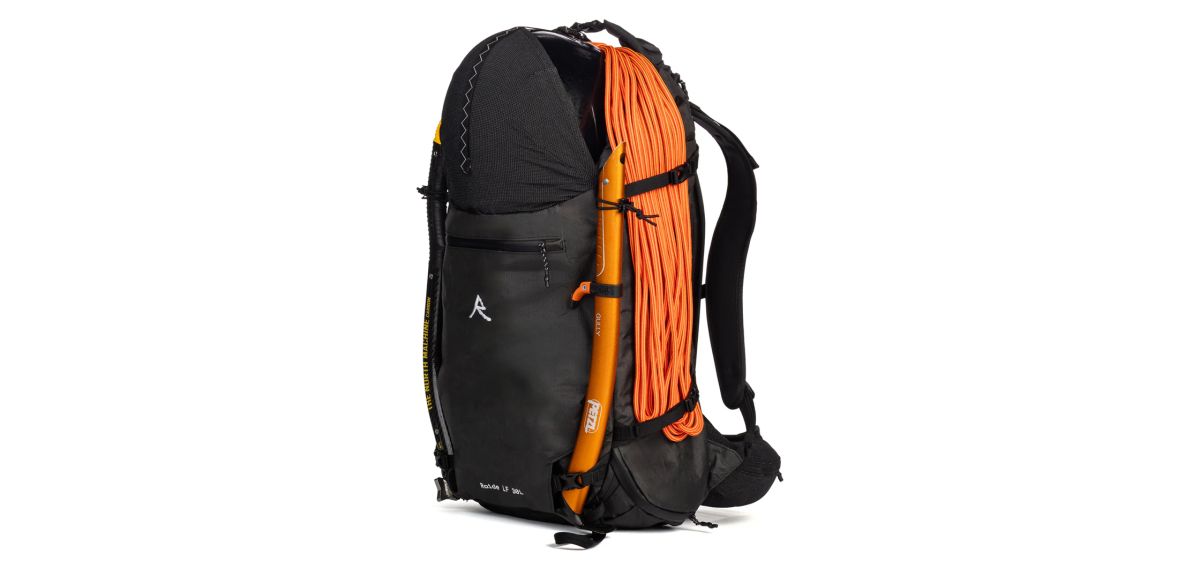
Raide's LF 30L pack is the best thought out pack for minimising the faff factor that I have come across. As the name suggests it is 30 litres, but a 40 litre version is also available with an identical feature set. Normally I'd go for the 40L, but it was out of stock and I thought I'd see if 30L was enough. It turns out, I don't need the extra space when everyhting is well-organised and efficiently designed. The LF 30L is stacked with useful features, I won't attempt to list them all, but my favourites are:
- top entry via the expanding roll top OR a horizontal zip
- back panel entry as an alternative to top entry to get at everything at once, the zip is stiffened/shaped by the back panel padding, meaning it slides very easily and doesn't snag
- a separate side compartment for probe and shovel handle, with one-handed external access without having to remove the pack
- a divided slot in the main compartment for your shovel blade/powder plates, including a drain hole
- elasticated glove holder on shoulder strap for rapidly stashing gloves on the move
- straps and loops for diagonal OR A-frame carrying of skis
- ice tool stowage that hides the pointy bits
- a stretchy zip pocket on the waistband
- An external sleeve for stuffing high use things like skins or a windproof layer
- the before-mentioned sleeve terminates in a shaped stretchy helmet holder
Many of these features can be found on other packs and none, besides maybe the helmet stash, is completely unique to Raide. But I haven't seen another pack that has all of these features together and implemented in such a functional way. Many other packs have detachable elasticated hairnet-style helmet holders. But these can be lost when detached or are snag-prone if left on. They are also commonly situated on the pack in a place that doesn't work at the same time as a ski carry. So if you are walking in on an approach carrying skis and not wearing your helmet, you have to come up with another idea. Raide's helmet carry works with both A-frame and diagonal ski carry, doesn't snag and can be used for quickly stashing a multitude of other items if you are too old-school to need a helmet when touring. It's my favourite feature.
Packing this many features in, the LF 30L should be a hefty pack, but it's not. At 1060g, it isn't the lightest ski-touring pack available, but it is definitely in the lightweight realm and without skimping on features. It also carries a load surprisingly well, as it still has a frame and padding, necessities often removed to hit a low weight target. Raide haven't sacrificed durability in pursuit of weight loss either, the main fabric is a 200 denier woven UHMWPE that is reportedly two times more tear resistant and eight times more abrasion resistant than similar ultralight fabrics. This fabric also has a hydrostatic head rating of 130k. I've had no durability issues with the pack so far and despite feeling light enough to float out of your hands, it is reassuringly well-made and doesn't give the impression of needing to be babied in the way some ultra light products do.
All this adds up to a really impressive combo and I've found in my use of the pack a significant reduction of faff time, less frustration from looking for the bit of gear I want, and less angst over organising my pack internals for best efficiency.
That isn't to say the LF 30L is perfect, but my quibbles are minor. I'll run through them nevertheless, to give as balanced a review as I can. Firstly, you pay plenty for a pack this good, made by a small scale brand from high-end materials and to a high quality. Current retail is US$499, not including shipping. If you happen to be in North America or the EU you don't pay any duty, but there's no local distributor in New Zealand at this time. You do get a five year guarantee though and, as someone who paid for this with their own money, I have no regrets about value for money.
Secondly, I always buy the largest version of things, within reason. These come in a S, M, or Tall/Long back version. By back length and height the Raide size chart had me well within the M range, but I do find the shoulder straps a little short, with the padding terminating at my armpit. It works, but if buying again I'd go for the largest size and recommend that approach for anyone over six foot and/or with shoulders more fleshy than a coat hanger. As part of this, the sternum strap wants to ride up uncomfortably high towards my throat and is only tenable at its lowest possible position. Each side of the strap is on sliders mounted to the shoulder straps, as has become common, but this means the sternum strap continually slides up to a position I don't want it in. I personally prefer a number of fixed positions for these types of straps, so you can move it to where you want and then it never leaves that position. Sliders are great if you need to constantly adjust the height, but for me that isn't necessary in a sternum strap. I've solved this problem by placing a quick release camera holder over the slider on one side so that the strap is trapped at its lowest possible position.
Thirdly, the external zip pocket doesn't have its own volume, beyond the pack's internal space. So, if the pack is full then it is difficult to get anything into or out of the pocket. Especially if you have big hands. This design of pocket is used by many other manufacturers though and I'd still rather have it like this than not be there at all—as it is useful for separation/organisation and its tightness adds a sense of security for crucial items like keys. It's just not the place to put a high use item.
All in all, this is a fantastic product and I recommend it wholeheartedly. While it is a dedicated ski/snowboard alpinism pack, many of its features are cross compatible with straight alpinism and I wouldn't hesitate to use it this way. I've taken it to Europe as my carry-on bag and it is a great size for that.